Termické TA

Termické TA

How does a thermal mass flow sensor (hot-wire anemometer) work?

The measurement principle is based on heat transer between a heated sensor element and the flowing medium.  An electrically heated wire transfers heat to the passing gas and cools down in the process. The change in electrical resistance is measured and converted into mass flow rate.

The advantage lies in the direct measurement of mass flow since no complex compensation for temperature and pressure is required. Unlike mechanical flow meters with moving parts, thermal systems operate without wear and are therefore particularly low-maintenance. 

Termické snímače průtoku / kalorimetrické průtokoměry / hmotnostní průtokoměry

What types of designs are available for thermal flow measurement?

Insertion probes can be used flexibly thanks to their simple installation and can be used in pipes with diameters as small as 25 mm. Installation and removal are performed using probe guide pieces; in pressurized pipelines additionally with ball valves.

The TA10 models respond even to very low flow velocities and can be used reliably at extreme values of over 200 Nm/s. They are designed for operating pressures up to 50 bar and, depending on the model, cover temperature ranges from -20 to +240° C. 

For smaller pipe diameters, inline sensors are used, which operate with inside diameters between 8 and 53.1 mm, measurement ranges from 0.04 to 1196 Nm³/h and extremely low measurement uncertainties. The temperature range here is also -20 to +240° C at pressures up to 50 bar. Custom solutions are available at any time.

Many models already include integrated transducers. Data can be transmitted via WLAN/WiFi, allowing analysis using any internet-enabled device. Additionally, interfaces such as two 4-20 mA analog outputs, media temperature output as well as bus systems like M-Bus or Modbus TCP are available.

What advantages does thermal flow measurement offer?

Thermal mass flow meters measure mass flow directly, eliminating the need for additional pressure or temperature sensors and significantly simplifying the measuring chain. This also increases the accuracy of the results. 

The devices are highly sensitive to low flow velocities and reliably measure even the smallest gas volumes. Since they have no moving parts, they are wear-free, durable and require minimal maintenance. Their use as calorimetric flow meters highlights the versatility of the measuring method.

Furthermore, Höntzsch's flow sensors are approved for use in hazardous areas (ATEX, CSA). They can also be sterilized with hydrogen peroxide (H2O2) for example as part of CIP and SIP processes.

Get Expert advice now!

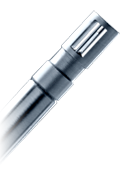
Základem termického snímače průtoku je elektricky vyhřívané a mechanicky chráněné tělísko, které je umístěné na měřícím konci snímače. Na základě přenosu tepla mezi tímto tělískem a měřeným plynem je vyhodnocena standardní (přepočtená, normovaná) rychlost proudění, standardní (přepočtený, normovaný) objemový průtok nebo hmotnostní průtok měřeného média.

Vzhledem k fyzikální podstatě měřící metody je výsledek měření nezávislý na aktuální teplotě a tlaku měřeného média.

Termické průtokoměry jsou prioritně určeny pro měření spotřeby / množství / hmotnostního průtoku zemního plynu, tlakového vzduchu a dalších technických plynů. V naprosté většině aplikací vzniká na snímači pouze zanedbatelná tlaková ztráta.

Termické hmotnostní průtokoměry jsou též vhodné pro dlouhodobě stabilní měření velmi malých rychlostí proudění (laminární proudění).

Příklady takových aplikací : měření laminárního proudění ve sterilních prostorách, v klimatizačních jednotkách, ve farmaceutickém, potravinářském a elektronickém průmyslu, jakož i monitorování průtoku a rychlosti proudění vzduchu v lakovacích kabinách, boxech chemických lázní a pod.

Stlačený vzduch. zemní plyn či jiné technické plyny jsou velmi drahé zdroje energie. Detekcí a lokalizací netěsností a úniků z potrubí, případně řízením výkonu kompresorů za pomoci termických snímačů průtoku můžeme dosáhnout významné úspory nákladů na tyto energie. Konstrukčně nemají termické průtokoměry jakékoliv pohyblivé / rotující části, jsou přesné, robustní a bezúdržbové. Dynamika měřícího rozsahu je až 1:1000, takže jimi mohou být spolehlivě měřeny i velmi malé průtoky odpovídající únikům v potrubí až po plný provozní rozsah, a to při tlacích až do 50 barů. Pro zpracování měřených dat a vyhodnocení spotřeb jsou vybaveny elektrickými výstupy – mA, pulsní výstup, M-Bus.

Naše kalorimetrické průtokoměry jsou vhodné i pro aplikace ve výbušných atmosférách (ATEX, CSA), například pro fixní nebo přenosné měření průtoku skládkových plynů.

Termické hmotnostní průtokoměry jsou vhodné všude tam, kde je požadována korekce průtoku na tlak a teplotu (přepočet na standardní / normované podmínky)

Příklady možných aplikací termických hmotnostních průtokoměrů jsou : měření spotřeby čistých plynů jako stlačeného vzduchu, skládkového plynu, dusíku, zemního plynu, propanu C3H8, metanu (CH4), butanu (C4H10), argonu (Ar), helia (He2), oxidu uhlíku (CO2), vodíku (H), hexafluoridu síry (SF6), ethanu (E2H2), atd., měření standardní / přepočtené rychlosti proudění od 0,08 m/s do 200 m/s, standardního / přepočteného průtoku od 0,04 m³/h, s časovou odezvou od 1 sekundy.

Kalorimetrické průtokoměry Höntzsch pro měření hmotnostního průtoku jsou dostupné jako zásuvné sondy do potrubí s vnitřním průměrem od 25 mm, nebo jako průtokoměry / měřící trasy s vnitřním průměrem od 8 mm.


What types of media can be used using thermal flow measurement?

Thermal measuring devices are particularly suitable for clean, dry and pure gases. 

  • Air and compressed air - for consumption measurement, leak detection and energy management
  • Process and fuel gases - natural gas, city gas, propane (C3H8), butane (C4H10), methane (CH4)
  • Industrial gases - nitrogen (N2), carbon dioxide (CO2), oxygen (O2), argon (Ar), helium (He)
  • Specialty gases - sulfur hexafluoride (SF6) for leak testing, ethyne (C2H2) for welding applications
  • Biogenic gases - landfill gas and biogas for monitoring energy and environmental processes
  • Future energy sources - hydrogen (H2) for industrial and energy applications

The most common fields of application for thermal sensors are for example:

  • Consumption quantity measurement for energy monitoring, energy management and in facility operations
  • Fixed and portable consumption quantity measurement in air and different clean gases
  • Detection of leaks in process plants
  • Performance monitoring of compressors
  • Aeration air in wastewater treatment tanks/nitrification tanks
  • Measurement of very low flow velocities
  • Laminar flow applications in clean rooms, laboratories, under fan-filter-units, in production areas of the pharmaceutical (glove boxes); food-processing- and semiconductor industry (isolators)
  • Monitoring of settling velocity for example in the automotive industry (paint booths)
  • For high-precision gas mass flow proportional measurements such as in engine test benches, climatic chambers, combustion control and supply burner air
  • Aerospace, on ships and boats

Get expert advice now!

Multigas applications and their areas of application

Thermal mass flow meters can be configured to measure various gases without requiring complex adjustments to the device. 

With the latest sensor generations, the same device, optionally equipped with M-Bus, can be used in hazardous areas category 3G and 3D (zones 2 and 22) without requiring recalibration or return to the manufacturer. This means that a single base unit is sufficient, simplifying handling during operation and storage.

The ability to easily switch between gases allows use even in systems with varying requirements. In addition, additional gases can be integrated at any time as special characteristics that are based on a real-gas calibration in our in-house laboratory. If you're interested we are happy to assist you with any further questions.

x