Ultrasonic UA Liquids

Measuring technology for flow rate, mass flow rate and flow velocity

Send enquiry now
Ultrasonic UA

Ultrasonic UA - ExactSonic III - portable ultrasonic flow meter for liquids

This principle of measurement is also referred to as the transit time difference method. For measuring the flow rate of liquids using this technique, ultrasonic pulses are sent and received simultaneously through the medium in the direction of flow and against it. The sensors work alternately as transmitter and receiver. The transit time of the acoustic signals filtered through the medium in the direction of flow is shorter than that against it. The difference in transit time Δt is measured and can be used to calculate the average flow velocity of liquids filtering through the acoustic path. After measuring the flow velocity and with the pipe cross-sectional area, volumetric flow can be calculated.

THE ULTRASONIC FLOW MEASURING METHOD PROVIDES MANY ADVANTAGES

These ultrasonic flowmeters have many benefits, for example, the measuring instruments produce accurate results in just a matter of minutes, they are easy to install and operate, there is no process interruption and there are no pipe restrictions. As a result, there is no pressure loss and therefore, time and cost savings as the ultrasonic flow meter is easy to install on the pipe.

Advantages of non-invasive measuring with the ultrasonic flowmeters:

  • installation without process interruption or shut-down
  • easy and cost-effective assembly
  • light-weight ergonomic design
  • ideal for use in maintenance areas and commissioning
  • testing fixed measuring equipment

Device-related advantages of the ultrasonic flow measurement equipment compared to other products:

  • no zero point alignment of the flow meter necessary
  • coverage of the most frequent industrial applications for flow measurement of liquids with just two transducer sets
  • high-capacity data logger with numerous parameters for pipe materials and mediums
  • stable and reliable results even under difficult conditions
  • excellent reproducibility of results

Measurement-related advantages of the ultrasonic flow meter:

  • non-contact measurement
  • independent of pressure, temperature, conductivity and viscosity
  • unlimited plant availability, as no process interruption
  • no pressure losses when measuring flow rate, no risk of leakage, no cleaning necessary
  • no mismeasurements as a result of blocked impulse pipes
  • logging of lowest flow velocities (min. 0.2 m/s) resulting in high measuring dynamics

Cost advantages of the ultrasonic flowmeters:

  • easy retrofitting
  • low-cost installation and upkeep
  • no maintenance effort or cleaning process necessary

resulting in an excellent cost-benefit ratio.

APPLICATIONS / MEDIUMS / INDUSTRIES FOR AN ULTRASONIC FLOW MEASURING INSTRUMENT

Flow rate measurement in liquid-filled pipes, HVAC systems, pump and technical system verification, boiler testing, leak detection, filter sizing, fire and hydraulic systems.
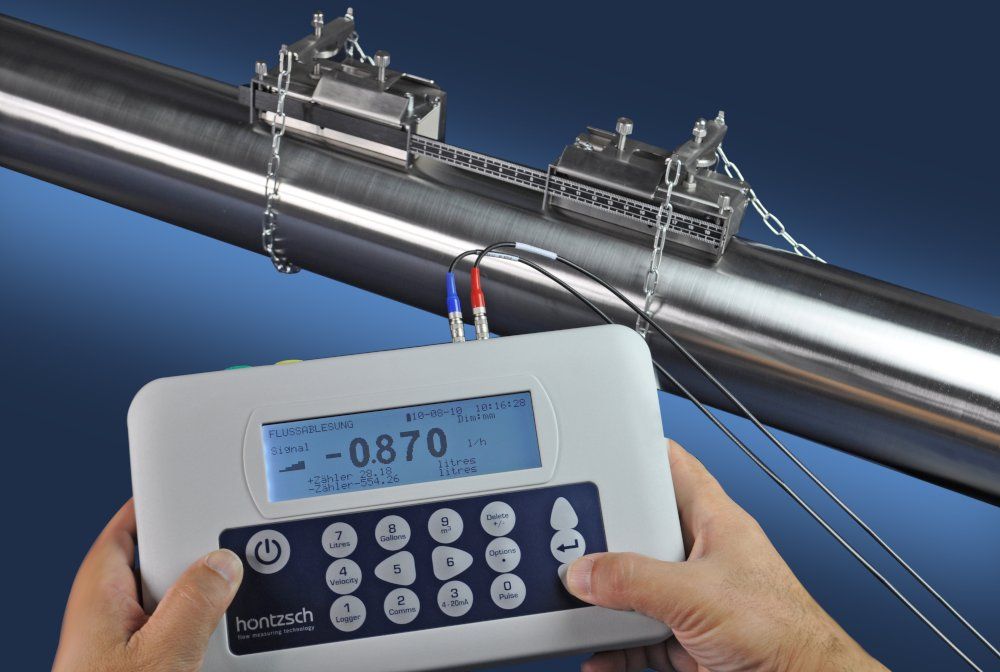
Non-contact measurement from the outside means that the ultrasonic flow measuring instrument is indispensable in many branches of industry, such as, water management, building services, energy sector, chemical and pharmaceutical, food technology and petrochemical.

Ultrasonic flow measuring instruments can be used in the following industries:

Chemical 
Aggressive, toxic, high-viscosity and non-conductive fluids

Petrochemical
Flow measurement of various intermediate or end products, e.g. tar, bitumen

Offshore Industry
Measuring liquid hydrocarbon

Power plants
Operational measuring of coolants and boiler feed water, condensate

Pharmaceutical, Semiconductor Industry
Ultrapure liquids / fluids

Beverage industry
Hygienic measuring in bottling plants or tank installations

Water / sewage
Measuring in large pipes and underground pipes and ducts

Plant engineering and construction
Any flow rate measurement, e.g. leakage detection in hydraulic plants, pump verification

Aerospace
Testing hydraulic, supply and cooling systems

These are just some examples of typical mediums in various branches of industry.

Other mediums suited for this principle of measurement:
de-mineralized water, drinking water, river water, water-glycol mixtures, hydraulic oil, diesel, fuel oil, petroleum products, etc.

Technical Data of the ultrasonic flow measuring instrument:

  • flow velocity range 0.2 … 20 m/s
  • bi-directional
  • measurement uncertainty: pipe OD > 75 mm: ± 2 % of measured value
  • menu-oriented operation
  • backlit graphic display, 64 x 240 pixels
  • programming via 16 key control panel
  • battery or mains operation
  • battery life up to 20 hours
  • power 110 … 240 VAC +/-10 %
  • user selectable languages: German, English, French, Russian, Spanish
  • incl. two transducer sets 'A' & 'B': pair 'A' for pipe OD 13 … 115 mm
    pair 'B' for pipe OD 50 … 2000 mm
  • transducer working temperature range: -20 … +135 °C
  • outputs 0/4-20 mA, USB, opto-isolated pulse output 5 V, max. 1 pulse/s
  • data logger: 8 GB data points, 20 named record blocks, display in text or graph format, download to USB-stick
  • delivered with robust IP67 carrying case
ExactSonic III - Portable Ultrasonic Flow Measurement

The ExactSonic III operates using the ultrasonic transit-time difference method, a precise and proven measurement principle. The sensors alternately transmit ultrasonic pulses through the medium in the direction of flow and against the flow. Each sensor alternately acts as both a transmitter and a receiver. 

Since sound signals travel faster in the direction of flow than against the flow, a measurable transit-time difference (Δt) results. This difference is precisely recorded, allowing reliable determination of the average flow velocity. 

Based on the determined velocity and the calculated pipe cross-section the device then calculates the volumetric flow rate - that is, the actual flow rate of the liquid. 

Send your enquiry now!

Measurement principle of Ultrasonic Flow Measurement

The principle of measurement behind ultrasonic flow measurement offers numerous advantages and has established itself as a reliable and efficient method. Users benefit from accurate measurement results within minutes, easy operation and flow measurement without interrupting the process.

Since the sensors are mounted on the outside of the pipe, there is no instrusion into the cross-sectionm which means there is no pressure loss. At the same time, the easy installation saves time and money.

Advantages of Ultrasonic Flow Measurement

Advantages of non-contact measurement with ultrasonic flow meters:

  • Installation during ongoing plant operation, without process downtime
  • Simple and cost-effective installation
  • High mobility thanks to low weight and ergonomic design
  • Ideal for use in service and comissioning
  • Quick inspection of stationary measuring systems

Advantages compared to other methods

Economic advantages 

  • Highly independent from medium properties such as conductivity, density, temperature or viscosity
  • No moving parts in the device
  • No internal components within the pipeline → no cross-section loss and no pressure drop
  • Virtually maintenance-free operation
  • No risk of clogging or leakage
  • Precise measurement even of lowest flow velocities starting at 0.2 m/s →  high turndown ratio
  • Easy retrofitting into existing systems
  • Low installation and operating costs
  • No cleaning or maintenance required for the sensors
  • Excellent cost-benefit ratio

Use and Application Examples of Ultrasonic Flow Rate Meters

Ultrasonic flow meters offer a wide range of applications for measuring the flow of liquids. Typical applications include:

  • Flow measurements in heating, air conditioning and ventilation systems
  • Monitoring and inspection of pumps and technical systems
  • Tests on boilers
  • Leak detection in pipelines
  • Filter and permeability measurements
  • Monitoring of fire extinguishing and hydraulic systems

The key advantage: Since there is no direct contact between the measuring device and the medium, ultrasonic flow measurement is particularly well-suited for industries with high requirements for safety, hygiene and process stability.


Send your enquiry now!


Applications for Ultrasonic Flow Meters

Chemical Industry

Measurement of corrosive, toxic, high-viscosity or non-conductive liquids

Petrochemistry

Flow measurement of intermediate and final products such as tar or bitumen

Offshore-Industry

Measurement of liquid hydrocarbons under demanding conditions

Power plants

Monitoring the flow of cooling water, boiler feed water or condensate

Pharma- and semiconductor industry

Measurement of high-purity fluid without the risk of contamination

Beverage industry

Hygienic flow control in filling and tank systems

Water and wastewater management

Reliable measurement even in large pipes or underground lines

Machinery and plant engineering

A wide range of applications, e.g. leak detection in hydraulic systems or pump monitoring

Aviation industry

Inspection of hydraulic-, supply- and cooling systems


Suitable measuring media

In addition to conventional media such as drinking water, river water and fully demineralized water, numerous specialty media can also be measured without any problems, including:

  • Water-glycol mixtures
  • Hydraulic oil
  • Diesel, heating oil and other petroleum products

Technical Specifications of the Ultrasonic Flow Meter

  • Flow velocity of liquids in pipelines from 0.2 to 20 m/s
  • +/- Flow direction detection
  • Measurement uncertainty: pipe OD > 75 mm: ± 2 % of the measured value
  • Menu-driven operation
  • Backlit display, resolution 64 x 240 pixels
  • 16-button control panel for parameter settings
  • Battery and mains power supply
  • Battery life up to 20 hours
  • Supply voltage 110 to 240 VAC +/-10 %
  • User languages: German, English, French, Russian, Spanish
  • Includes two pairs of measuring transducers 'A' & 'B': pair 'A' for pipe-OD 13 to 115 mm pair 'B' for pipe-OD 50 to 2000 mm
  • Temperature range of measuring transducer pairs: -20 to +135 °C
  • Outputs 0/4-20 mA, USB, opto-isolated 5V pulse output, max. 1 pulse/s
  • Data logger: 8 GB, 20 indexable recording blocks, display in text or graphical form, copy to USB flash drive
  • Supplied with a robust IP67 carrying case
x

Do you have any questions?

Contact us at +49 07151 1716-66 or send us an email at sales@hoentzsch.com

We will be happy to assist you!

Follow us on LinkedIn and YouTube